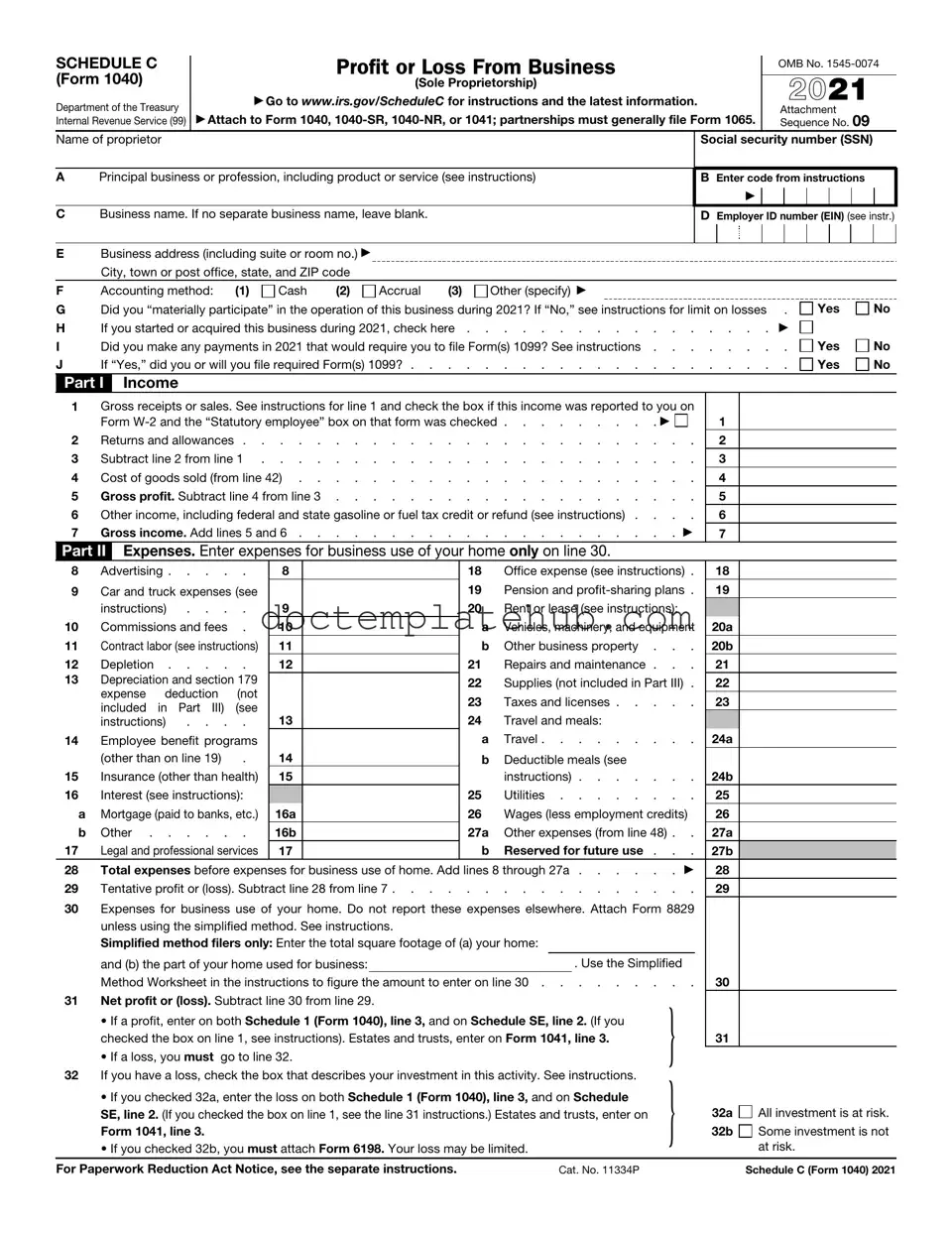
Fill Your IRS Schedule C 1040 Form
For many self-employed individuals and small business owners, the IRS Schedule C (Form 1040) serves as a crucial tool for reporting income and expenses. This form allows taxpayers to detail their business activities, providing a clear picture of their financial performance over the year. Key sections of the Schedule C include areas for reporting gross receipts, cost of goods sold, and various business expenses such as advertising, utilities, and travel. Accurate completion of this form is essential, as it directly impacts the calculation of net profit or loss, which in turn affects overall tax liability. Furthermore, understanding the nuances of deductions available on Schedule C can significantly influence a taxpayer's financial outcome. By carefully documenting income and expenses, self-employed individuals can not only comply with tax regulations but also strategically manage their business finances.
Similar forms
The IRS Schedule C form is similar to the IRS Form 1040, which is the standard individual income tax return. Both forms are essential for reporting income and calculating tax liability. While Form 1040 serves as the primary document for individuals to report all sources of income, Schedule C specifically focuses on income earned from self-employment. This means that if you run a business or are a freelancer, you will use Schedule C to detail your business income and expenses, which then flows into your overall tax return on Form 1040.
Another document that resembles Schedule C is the IRS Form 1065, which is used by partnerships to report income, deductions, and credits. Like Schedule C, Form 1065 provides a detailed breakdown of income and expenses. However, while Schedule C is for individual sole proprietors, Form 1065 is designed for multiple partners sharing the profits and losses of a business. Both forms require meticulous record-keeping to ensure accurate reporting of financial activities.
IRS Form 1120 is also similar to Schedule C, as it is used by corporations to report their income and expenses. While Schedule C is for sole proprietors, Form 1120 serves C corporations. Both documents require a comprehensive overview of business activities, including revenue, costs, and deductions. However, the tax rates and implications differ significantly between individual business owners and corporations.
IRS Form 1120-S, used for S corporations, shares similarities with Schedule C in that both forms report income and expenses for businesses. S corporations, like sole proprietorships, pass their income through to shareholders, who report it on their personal tax returns. Schedule C provides a simpler format for individuals, while Form 1120-S has more complex requirements due to the corporate structure.
Form 1065-B, which is for electing large partnerships, is another document that parallels Schedule C. Both forms focus on reporting business income and expenses. However, Form 1065-B is tailored for partnerships that have opted for a special tax treatment, allowing them to file a simplified return. Schedule C remains focused on individual business owners, providing a more straightforward approach for self-employed individuals.
IRS Form 990 is relevant for tax-exempt organizations and shares some reporting characteristics with Schedule C. Both forms require detailed financial disclosures about income and expenses. However, Form 990 is designed for non-profit organizations, while Schedule C is strictly for individuals engaged in business activities. The purpose and tax implications differ significantly, but both require transparency in financial reporting.
For those looking to secure a rental property, understanding the specifics of the Georgia Rental Application process is crucial. This form not only collects vital information from prospective tenants but also facilitates a smoother evaluation and approval process for landlords. Completing this form ensures all necessary details are provided, allowing for informed decision-making when it comes to leasing arrangements.
Form 941, the Employer's Quarterly Federal Tax Return, is another document that relates to Schedule C. While Schedule C focuses on self-employment income, Form 941 is for employers to report wages paid and taxes withheld from employees. Both forms require accurate financial reporting, but they cater to different business structures and tax responsibilities.
IRS Form W-2, which reports wages paid to employees, is similar to Schedule C in that both involve income reporting. However, W-2 is used by employers to report employee earnings and withholdings, while Schedule C is for self-employed individuals to report their business income. Both forms play crucial roles in the tax reporting process, but they serve different purposes in the context of employment and self-employment.
Lastly, IRS Form 1099-MISC is akin to Schedule C in that it reports income received by non-employees, such as independent contractors. While Schedule C is used to report income from self-employment, Form 1099-MISC is issued by businesses to report payments made to contractors. Both forms are integral to understanding income sources, but they apply to different types of earners and reporting requirements.
Other PDF Templates
Puppy Health Record - Eyes opening is a significant developmental stage noted on this form.
In the realm of business and legal agreements, understanding the significance of a Michigan Non-disclosure Agreement form is crucial. This form serves to protect confidential information, ensuring that proprietary details remain secure and are not shared indiscriminately. For those looking for a comprehensive template, resources such as smarttemplates.net can provide valuable tools to create a binding agreement that safeguards sensitive information.
What Is Schedule C - Provides a foundation for financial ratios and metrics.
More About IRS Schedule C 1040
What is IRS Schedule C (Form 1040)?
IRS Schedule C is a tax form used by sole proprietors to report income and expenses from their business. It is part of the individual income tax return, Form 1040. This form allows you to detail your business income and claim deductions for expenses incurred in the course of running your business.
Who needs to file Schedule C?
Individuals who operate a business as a sole proprietor must file Schedule C. If you earn income from self-employment, freelance work, or any business activity not registered as a corporation or partnership, you will need to complete this form. Even if your business is part-time, you must report the income and expenses.
What types of income should be reported on Schedule C?
All income earned from your business activities must be reported. This includes sales revenue, commissions, fees, and any other income related to your business operations. Even if you receive cash payments, you are required to report that income on Schedule C.
What expenses can I deduct on Schedule C?
You can deduct various business expenses on Schedule C, including costs for supplies, utilities, rent, advertising, and employee wages. Home office expenses may also be deductible if you use part of your home exclusively for business. Keep detailed records of all expenses to substantiate your claims.
How do I calculate my net profit or loss on Schedule C?
To calculate your net profit or loss, start by adding up your total income. Then, subtract your total business expenses from that amount. If your income exceeds your expenses, you will report a net profit. Conversely, if your expenses are higher, you will report a net loss.
Can I file Schedule C electronically?
Yes, you can file Schedule C electronically using tax software or through a tax professional. Many tax preparation services offer e-filing options, which can speed up the processing of your return and any potential refund.
What should I do if I have a loss on my Schedule C?
If you report a loss on Schedule C, you can use that loss to offset other income on your tax return, which may reduce your overall tax liability. However, if you consistently report losses, the IRS may scrutinize your business activity to determine if it is a legitimate business or a hobby.
Where can I find IRS Schedule C and related instructions?
You can find IRS Schedule C and the accompanying instructions on the IRS website. The forms are available for download and can also be obtained through many tax preparation services. Make sure to use the correct version for the tax year you are filing.
Dos and Don'ts
When filling out the IRS Schedule C 1040 form, it's important to follow certain guidelines to ensure accuracy and compliance. Here are four things to do and four things to avoid.
Things You Should Do:
- Read the instructions carefully before starting.
- Keep accurate records of all income and expenses related to your business.
- Use clear and precise language when describing your business activities.
- Double-check your calculations for accuracy.
Things You Shouldn't Do:
- Don't leave any sections blank; provide information for all applicable fields.
- Avoid estimating income or expenses; use actual figures.
- Do not mix personal and business expenses; keep them separate.
- Don't forget to sign and date the form before submission.
IRS Schedule C 1040 - Usage Steps
Filling out the IRS Schedule C (Form 1040) is an important step for self-employed individuals or those running a business as a sole proprietorship. This form helps report income and expenses, providing a clear picture of your business finances. Follow these steps to complete the form accurately.
- Gather necessary documents, including income statements, receipts for expenses, and any other relevant financial records.
- Begin with the basic information section. Enter your name, Social Security number, and business name if applicable.
- Indicate your principal business activity by selecting the appropriate code from the IRS list provided in the instructions.
- Fill in your business address, including city, state, and ZIP code.
- Report your gross receipts or sales. This is the total income your business earned during the year before any expenses.
- Subtract any returns and allowances from your gross receipts to calculate your net receipts.
- List your business expenses in the appropriate categories. Common categories include advertising, car and truck expenses, and utilities.
- Calculate your total expenses by adding up all the amounts from the expense categories.
- Subtract your total expenses from your net receipts to determine your net profit or loss.
- Complete the rest of the form, including any additional sections that apply to your business situation.
- Review the form for accuracy and completeness before signing and dating it.
Once you have filled out the Schedule C form, it can be submitted along with your Form 1040 when filing your taxes. Ensure you keep a copy for your records.